Showing posts with label space. Show all posts

Tuesday, May 15, 2012

Let's Build the Starship Enterprise!

I've said it before, and I'll say it again--we should fund a spaceship Kickstarter for a REAL spaceship. It's by no means a new idea, but someone has finally made a case for a workable plan.

The founder of the Build the Enterprise website, BTE Dan, says he's got an idea to build the starship Enterprise (or a reasonable version of it) to fly in actual outer space in 20 years.

Granted, there will be a few concessions (i.e., no warp speed) but he contends that the technology and know-how to construct an interplanetary space vessel exists--and we can do it in just two decades.

From the Build the Entperise FAQ:
Q: BTE-Dan, do you really think it’s technically possible to build the USS Enterprise over the next two decades?

A: Yes. It’s within our technological reach to build a full-sized Enterprise with 1g gravity. This Gen1 Enterprise can go on missions to key points of interest in our solar system, like Mars and Venus. It will be the biggest ship of any kind ever built by humans, and it will be larger than the tallest building in the world. It’s possible to build the Enterprise, and it would be a monumental achievement for us humans who inhabit the planet earth.

Q: How would building the Enterprise alter our manned space program?

A: The USS Enterprise from Star Trek is a cultural icon, and we should latch part of the US space program on to this icon and build from there. We need a far grander vision of what we should be doing to get humans up into space and how we might gain a permanent foothold there. If we aren’t going to get a sustainable presence up there, then we should stop spending money for putting humans into space and instead focus on robotic missions like sending more advanced rovers to Mars, Venus, and elsewhere. If we are going to ask taxpayers to pay billions of dollars for projects to put Americans into space, it should be for an idea that they can relate to and be inspired by. The general form and characteristics of the spaceship should be inspirational – and building the first generation of USS Enterprise would surely be inspirational.

Q: Well the ship is inspired by the Star Trek Enterprise, but it’s not the same. Please explain why it’s different.

A: It’s different because the technologies we have to work with in the first half of the 21st century are much different than the technologies that will exist in the 23rd century when Star Trek is set. We can only dream of what technologies may exist by then. So we can stay as true to the themes of the Enterprise ship as is possible given our technological limitations. We have to re-configure interior sections of the ship quite a bit. But it will still be a magnificently impressive ship. When completed, and given the missions that it will be capable of doing, it will be as inspirational as putting astronauts on the moon in 1969.
He makes a reasoned argument for realizing a spaceship, (I'll give him that!) though I think with it would likely take about twice that time to shake out any technical snafus along the way. Still, that's a mere fraction of the 2 and a 1/2 centuries that the Star Trek series postulates the possibility of the Enterprise. And really, who would give up cruising around the solar system in their own hot rod?

Here's a video of a proposed artificial gravity wheel to accomodate human habitation on long journeys. It's a neat solution that essentially turns the manned areas of the ship on it's side.


If only we could get an X Prize to build one of these!

Links:

Wednesday, May 9, 2012

Martian test run in Austrian ice caves!

These amazing photographs are of a simulation experiment in ice caves located underneath Dachstein mountain in Austria that are serving as a test environment for space suits. Why would we need to test space suits in a cave? you ask. Well, so when we go to MARS we can see if perhaps life found a way to thrive underground.  


As you can see from these last two images, the trial also includes some rover robot testing. Pretty cool!


See caves are a great place for microbes to hang out because they benefit from a protected habitat that shields them from cosmic radiation, which is a known buzzkill when it comes to biology.

From Spiegal:
A dozen experiments are being conducted simultaneously in the caves. For example, the Magma Mars rover developed in Poland is navigating an ice surface. On board, it is carrying the Wisdom radar system, which is to be used on the next European Mars mission. The system can be used to analyze rocks at a depth of up to 3 meters (almost 10 feet). "Here in the ice, we can even examine as far as 10 meters deep," says project worker Stephen Clifford of the Lunar and Planetary Institute in Houston.

Without a doubt, though, the most spectacular test object is the "Aouda.X" Mars space suit. Tester Daniel Schildhammer is currently making his way in the space suit simulator through a giant cavern that is dotted with rocks. The shining silver suit, which weighs 45 kilograms (around 100 pounds), is also one of a kind, and is named after a Jules Verne character. In his classic novel "Around the World in 80 Days," the book's hero, Phileas Fogg, falls in love with the Indian princess Aouda.
Researcher Gernot Grömer, an astrophysicist at the University of Innsbruck goes on to talk about what makes caves ideal test environments.
"We've known for some time now that there are caves on Mars. And if there actually was life on its surface once, then they would have been the ideal places to retreat to." In astro-biological terms, there is certainly something to that: Cave systems, with their constant temperatures, elevated levels of humidity and, in particular, the protection they offer from cosmic radiation, seem the perfect refuge for simple life forms seeking a retreat. Still, the impressive images Dachstein has to offer were certainly a very pleasant side-effect for all the stakeholders.
Even got a little Jules Verne in there! Great stuff. Reminds me of another post a ways back.

This all is helping me close in on an idea I've had since that initial post on the crystal caves. Just amazing that we have these incredible images and research like this is actually being conducted. I'm in awe!


Image sources:
Spiegel Online
blog.oewf.org

Props to Boing Boing

Friday, May 27, 2011

Understanding Dark Matter: What We Don't Know

I saw this great video on Boing Boing and thought I'd share in light of the new dark planets discovery. I've read comments on a few sites that the rogue, Jupiter-like planets must help explain the massive amounts of dark matter out there in the universe. Judging by what I've read elsewhere--and this cool animated film--it's more complicated than meets the eye. Stuff like this is part of the reason I love astronomy, it's still new and we still don't know a lot!

Enjoy!

Wednesday, May 18, 2011

BILLIONS of rogue planets in the Milky Way may outnumber stars!


Astronomer's have made a startling discovery that there are "hundreds of billions" of orphaned, Jupiter-sized planets in our galaxy. In fact, these free-floating orbs may outnumber the stars! From NYT:
There are two Jupiter-mass planets for each of the 200 billion stars in the Milky Way galaxy, according to measurements and calculations undertaken by an international group of astronomers led by Takahiro Sumi, of Osaka University in Japan, and reported in the journal Nature.

“It’s a bit of a surprise,” said David Bennett, a Notre Dame astronomer, who was part of the team. Before this research, it was thought that only about 10 or 20 percent of stars harbored Jupiter-mass planets. Now it seems as if the planets outnumber the stars.
I wonder if they also have moons like the gas giants in our neck of the woods. At least one of the scientists seems to postulate as much, From Nature:
Planetary scientist David Stevenson at the California Institute of Technology in Pasadena has considered how the temperatures on ejected planets might compare with those on star-bound bodies2. If Jupiter were kicked out of the Solar System, its surface temperature would drop by only about 15 kelvin, he says – although it would still be unsuitable for supporting life. However, "when you eject a planet that is quite massive, it could have carried along an orbiting body", Stevenson adds. "And that might be a more attractive possibility for life."

Unbound Earth-mass planets might still be capable of carrying liquid water, Stevenson says, even in the frozen reaches of interstellar space – as long as they have a heat-trapping hydrogen atmosphere. "That can bring the surface temperature up to 300 kelvin [about 27 °C]," he says. "And then you can have oceans."
What's your take on these newly discovered orphan worlds?

Learn more

Friday, May 6, 2011

Amazing Timelapse Video of the Milky Way


The Mountain from Terje Sorgjerd on Vimeo.

Photography blog Shuttersalt says:
Terje Sorgjerd, the photographer behind the viral video The Aurora, has done it again. Here, Sogjerd captures the Milky Way over El Teide, Spain’s highest mountain.
You can also click through to see how the video was made.

Stunning!

Friday, March 18, 2011

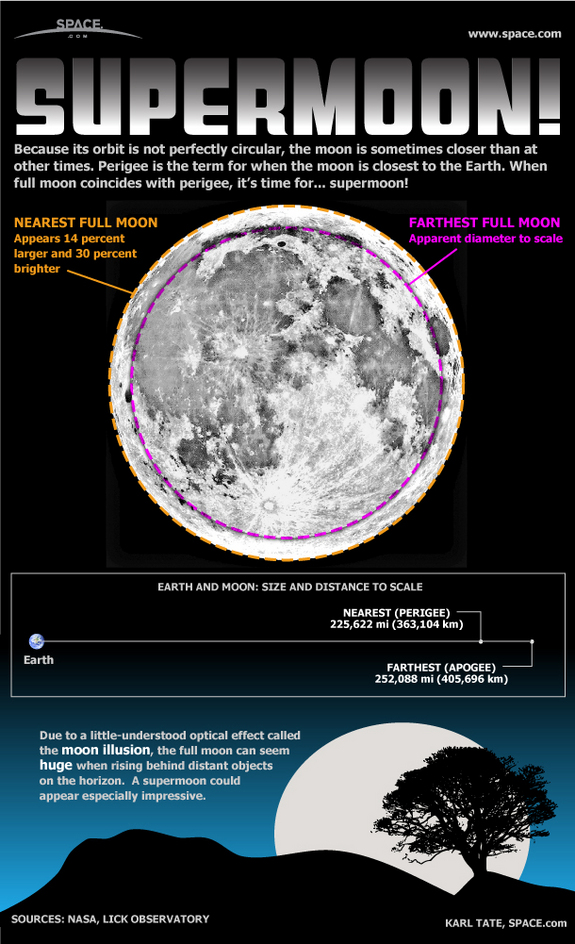
Are you ready for this weekend's SUPERMOON?

Learn what makes a big full moon a true 'supermoon' in this SPACE.com infographic.

On Saturday, March 19, at 3:00 p.m. Eastern time, the SUPERMOON arrives! The moon will appear bigger due to it's orbit, the moon will appear bigger, brighter, and more beautiful than usual.

From Space.com:
At its peak, the supermoon of March may appear 14 percent larger and 30 percent brighter than lesser full moons (when the moon is at its farthest from Earth), weather permitting. Yet to the casual observer, it may be hard to tell the difference.

The supermoon will not cause natural disasters, such as the Japan earthquake, a NASA scientist has stressed.
That's a relief! There will however be slight effect on ocean tides. For the full story and more moon facts, check out the Space.com.

So get your cameras, binoculars, and telescopes and get out there and have a peek at the largest moon in nearly two decades!

Tuesday, November 2, 2010

NASA, DARPA: Colonization is a 1-Way Trip, Sign Up Now!


NASA and DARPA (it's not just a made-up shadow org from Lost!) want you to know that they're ready to colonize space. They're collaborating on a joint venture to develop a 100-year spaceship that would take humanity into the firmament and establish permanent, extra terrestrial human colonies.

From Pop Sci:
"The human space program is now really aimed at settling other worlds,” Worden [a guy at NASA] said, according to a Singularity University blog that covered the event. “Twenty years ago you had to whisper that in dark bars and get fired.” (Worden added that he was fired by President George W. Bush.)

 Rock collecting would be a big hobby on Mars! Image: NASA.
Love that last part. So the real question here is: would the settlers ever get a chance to come home? No.
Next question. Seriously, this means they're shipping your ass off to MARS, some moon to be terraformed, or some inhabitable exoplanet, packing a lunch, and leaving you at the door of the school house. Forever.

They'll totally send you care packages of raw materials, equipment, and Soylent Green though. Hopefully, FedEx has a Red Planet
They would get periodic supply missions, but they would be expected to fend for themselves for water, shelter, nutrients and mineral/chemical processing. They would be expected to develop some kind of homegrown Martian industry, which could ultimately serve as a hub for an expanded colonization program. Plus, leaving some people on another planet would probably ensure that we’d want to go back, to visit them and see what they created.

Such a mission would save money, the authors say, because the prohibitive costs (in dollars and payload) of a manned Mars mission are mostly associated with bringing the astronauts home.
Oh, and that last point is the main reason it's a one-way gig--cost. See, coming back is expensive, and it's easier to cut costs if you just stay put. But you'll be a totally cool SPACE PIONEER. And a HERO to all humanity.

So....not you've got that going for you!

Tuesday, June 15, 2010

Space Junk Threatens to Smash Us to Bits!

Image: space junk that fell to Earth on a farm in Australia in 2008. Ouch! Via: Sydney Morning Herald
Well judging by what the news has to say, there's plenty of actual space junk to keep me inspired for many more Random Space Finds posts. NASA even set up an office and full-time junk tracker to keep an eye on all that detrius. Wired has an excellent feature story on the pollution of space--at least that space immediately around our planet and the man charged with tracking it all, Donald Kessler. He wrote a paper clinching the argument for keeping one eye on the sky that painted a "nightmare scenario". Here's some choice quotes:
Spent satellites and other space trash would accumulate until crashes became inevitable. Colliding objects would shatter into countless equally dangerous fragments, setting off a chain reaction of additional crashes. “The result would be an exponential increase in the number of objects with time,” he wrote, “creating a belt of debris around the Earth.”

At age 38, Kessler had found his calling. Not that his bosses had encouraged him to look into the issue—”they didn’t like what I was finding,” he recalls. But after the paper came out, NASA set up the Orbital Debris Program Office to study the problem and put Kessler in charge. He spent the rest of his career tracking cosmic crap and forming alliances with counterparts in other nations in an effort to slow its proliferation. His description of a runaway cascade of collisions—which he predicted would happen in 30 to 40 years—became known as the Kessler syndrome.

Image: actual map of space junk orbiting our Pig Pen-like planet, via Discovery.com 

Kessler is now in his 70s and he was of course proven frighteningly correct. And just in case you were skeptical about how much space crap is floating around up there:
The operations center moved quickly to double its computer capacity. By early 2010, it was keeping a close eye on 1,000 active satellites, 3,700 inactive satellites and rocket pieces, and another 15,300 objects the size of a fist or larger—a level of awareness that revealed a much higher daily average of 75 possible collisions. And that’s ignoring the danger posed by the estimated half-million smaller pieces of debris the size of a marble or larger. Too small to track from the ground, each of those tiny projectiles is capable of severely damaging a satellite.
There's even a testing range in White Sands, NM that tests how dangerous our leftovers in the black can be:
...technicians operate a cannon that uses gunpowder and pressurized hydrogen to fire plastic slugs at shields and panels. Just like real space junk, the projectiles can approach speeds of 5 miles per second. [Emphasis mine, as if it need it!]
Duck and cover folks!

Monday, April 26, 2010

Hawking: Alien contact "risky" for humans, death rays hard to duck

Hawking: avoid space aliens
Smartest guy in the known universe and all around inspiration, Stephen Hawking, has a message for everyone wanting to dial up aliens on the galactic party line: don't. On his new Discovery Channel series, Into the Universe with Stephen Hawking, the good professor warns that aliens might really be of the Hollywood variety. From ABC News:
"If aliens visit us, the outcome would be much as when Columbus landed in America, which didn't turn out well for the Native Americans," he said. "We only have to look at ourselves to see how intelligent life might develop into something we wouldn't want to meet."
Read the rest and then find a table to hide under (not that it would help...)

Space "Taxis" Make for Cheaper, Less Complicated Flights

Image: Boeing
The future of spaceflight is streamlined, cheap flights with no need for bells and whistles--like say, airlocks. MSNBC analyst James Oberg has a great piece on how private space corporations are aiming for inexpensive vehicles that get astronauts from point a to point b without having to spend a lot of time in orbit or performing other tasks. Since the main mission would be immediately dock with a space station or ship already in orbit, NASA and other agencies are looking at vehicles akin to the Soyuz class capsules or something similar to the Gemini/Mercury programs that the US sent up in the 60s. Oberg puts up a few design suggestions of his own:
  • Electrical power? Batteries are fine — recharge when you reach the station, or if you can’t, land immediately. No solar panels, no fuel cells, nothing complex or exotic.
  • Navigation? Big radar dishes, even complex transponders, are unnecessary, with differential GPS navigation now the baseline for most flying all over the planet.
  • Spacewalking? No need, so no airlock, either. At most, the crew would wear in-cabin pressure suits such as those used on Soyuz missions.
  • Passenger accommodations? Room for each passenger in a foldaway seat, and space to turn around if desired would be more than adequate for the short flight. No exercise equipment would be needed. No DVD library.
  • Hygiene? A maximum of 24 hours of independent flight suggests a minimum toilet (or just Apollo-era plastic bags with sticky openings). Or low-residue pre-launch diets, and diapers.
  • Passenger comforts? None. Forget hot food and a complex galley. Box lunches will do. Forget even windows, except for the pilot’s view forward at docking. There need only be minimal carry-on luggage — a take-aboard allowance that would make today’s commercial airlines seem generous.
  • Bulky docking hardware? These mechanically robust components are often a significant fraction of a spaceship’s weight, but the space station can also now grapple a nearby vehicle and emplace it gently on the desired berthing interface.
Read the full article...
Boeing has it's own design for future capsules (as pictured above)

Wednesday, April 7, 2010

New "Goldilocks" exoplanet discovered

Image: Instituto de AstrofĂ­sica de Canarias via ScienceNews
The first observable exoplanet, within an "Goldilocks Zone" has been discovered! This is a HUGE discovery as planets within the zone are considered excellent candidates for supporting life due to their not-too-close/not-to-far distance from their parent star. This "just right" distance allows for liquid water to exist on the surface--making for a comfy environment for life to flourish.

The planet, a gas giant roughly the size of Jupiter or Saturn, is designated as COROT-9b, but it's thought that if Jupiter can have moons, then why not COROT? The moons could be habitable, even if the main planet is not.

While other Goldilocks planets have been discovered, COROT is a diamond in the rough because it's much more easily observable from Earth. From ScienceNews:
Although a number of extrasolar planets with moderate temperatures have been discovered, only a planet that passes in front of — or transits — its star can be studied in depth. The starlight that filters through the atmosphere of the planet during each passage reveals the orb’s composition, while the amount of starlight that is blocked outright indicates the planet’s size.

All the other transiting planets seen so far have been “weird — inflated and hot” because they orbit so close to their stars, notes study collaborator Didier Queloz of the Geneva Observatory in Sauverny, Switzerland. Deeg, Queloz, and their colleagues report their findings in the March 18 Nature.
The planet is 1,500 light years away  (in the constellation Serpens), so it will be a while before we get to stop in on the neighbors and say hello!

Read the full article.

Tuesday, March 30, 2010

NYT: "Large Hadron Collider Finally Smashing Properly"

Best headline of the week (so far) and best nerd news all around! From the Grey Lady:
Following two false starts due to electrical failures, protons whipped to more than 99 percent of the speed of light and to energy levels of 3.5 trillion electron volts apiece around a 17-mile underground magnetic racetrack outside of Geneva a little after 1 p.m. local time. They crashed together inside apartment-building sized detectors designed to capture every evanescent flash and fragment from microscopic fireballs thought to hold insights into the beginning of the world.

The soundless blooming of proton explosions was accompanied by the hoots and applause of scientists crowded into control rooms at CERN, the European Organization for Nuclear Research, which built the collider. The relief spread to bleary gatherings of particle physicists all around the world, who have collectively staked the future of their profession on the idea that the new collider will eventually reveal new secrets of the universe, like the identity of the dark matter that shapes the visible cosmos and the strange particle known as the “Higgs,” which is thought to imbue other particles with mass. Until now, these have been tantalizingly out of reach.
Congrats to the scientists at CERN. Send them a thank you that we may now all enter our own personal pocketverses.

Full New York Times article

Wednesday, February 3, 2010

Crystal meteorite has crunchy nougat center harder than diamond

Scientists recently discovered that crystals inside a meteorite that fell to Earth (Finland, actually) in 1971 are actually harder than diamonds. Harder than diamond substances have been created in laboratory settings by combining other substances (boron or nitrogen seem to be en vogue these days). But researchers haven't seen naturally occurring harder-than-diamond material until now. From MSNBC:
A closer look with an array of instruments revealed two totally new kinds of naturally occurring carbon, which are harder than the diamonds formed inside the Earth.
"The discovery was accidental but we were sure that looking in these meteorites would lead to new findings on the carbon system," said Tristan Ferroir of the Universite de Lyon in France.
...and...
"The only evidence we have for a higher hardness than diamond is the fact that we polished the rock section with a diamond paste and that our polymorph and polytypes were not polished by this material," said Ferroir. "This why we do think that its hardness is harder than diamond."
And no, there was not a male infant inside the meteorite upon it's descent the Earth. ;)

Full story.
Wow, and I already had crystals on the brain this week! I sense a convergence coming....

Tuesday, February 2, 2010

First evidence of asteroid collision spotted by Hubble

I wouldn't call Harry Stamper just yet, but NASA is reporting that the first photos of an apparent collision between two asteroids have been taken by the Hubble space telescope. Wired has the story:
If it’s confirmed by further observations, it would be the first time that scientists have detected the interplanetary collision between objects in the asteroid belt, though they believe that such occurrences are common.
The complex structure of the debris is what makes astronomers think they may be seeing something new around the sun. The main nucleus of the object, P/2010 A2, is actually located outside its dust halo, something that’s never been seen in a comet-like object before.
and....
“If this interpretation is correct, two small and previously unknown asteroids recently collided, creating a shower of debris that is being swept back into a tail from the collision site by the pressure of sunlight,” Jewitt said.

Tuesday, January 19, 2010

Diamonds on Uranus the Size of Icebergs!


 Photos: NASA
And Neptune too! Scientists now speculate that Uranus (yes, I'm just going to keep saying "Uranus") has oceans of liquid diamond that may also have solid "icebergs" of diamond floating on the surface. Apparently diamond is quite common in the solar system (really?) but the boiling point hasn't been previously measured. You might not think that Uranus is hot (Ha! Been waiting for that one!) but boiling--and by extension melting or vaporizing a material--also takes intense pressure. Which, as it turns out, Uranus has lots of pressure. (Must be those old jeans!).

Anyway, Discovery Networks explains how the scientists were able to replicate the science in a lab:
When the pressure dropped to about 11 million times the atmospheric pressure at sea level on Earth and the temperature dropped to about 50,000 degrees solid chunks of diamond began to appear. The pressure kept dropping, but the temperature of the diamond remained the same, with more and more chunks of diamond forming.

 Then the diamond did something unexpected. The chunks of diamond didn't sink. They floated. Microscopic diamond ice burgs floating in a tiny sea of liquid diamond. The diamond was behaving like water.
With most materials, the solid state is more dense than the liquid state. Water is an exception to that rule; when water freezes, the resulting ice is actually less dense than the surrounding water, which is why the ice floats and fish can survive a Minnesota winter.
So there you go, a concise explanation for diamond oceans and ice fishing in Minnesota all in one tidy package.

Read more...

Meanwhile, on Neptune....

Hey! Uranus ain't the only one with diamonds! 

Yeah, yeah, whatever...


UPDATE! Scientists say they're launching a probe in the near future:


Seriously, I better stop because I could do this all day.

Wednesday, January 13, 2010

Mystery Object Hurtling Towards Earth TODAY!


Photo: E. Guido and G. Sostero / AFAM / CARA via MSNBC
Scientists have identified and object that will pass the Earth (but won't hit it) sometime today. In a somewhat disconcerting twist, they don't know what it is. It's going to fwoosh by, missing us by only 80k miles (that's a third of the distance from here to the moon just FYI). Calm yourselves people! We can get through this. See, it's only  about 10 meters wide, which turns out to be a good thing because (from MSNBC):
.....the "asteroid," or whatever it is, gives us a new standard: A 10-meter-wide (33-foot-wide) asteroid can be detected two days before it potentially hits Earth.
That's supposed to be COMFORTING? 
What makes this near-Earth object, or NEO, special is that it has an orbital period of almost exactly one year. This fact has led some scientists to speculate that 2010 AL30 could be an artificial object and not an asteroid.
So it's space junk? But couldn't it still cause some damage?
It is worth noting that even if 2010 AL30 did hit Earth, it would most likely explode high in the atmosphere (with the energy of a small nuclear bomb), posing little danger to anyone on the ground. Impacts of this size happen every year.
Well that makes me feel better! Unless it's artificial and not made by humans.....

Read more about about this impending doom from above interesting space anomaly.

UPDATE: Wired posted an update (it is an asteroid) and some new images, including an animation of the fly by.

Sunday, January 3, 2010

Lava Tube Awaits Lunar Colonization


Photo: ISAS/JAXA/Junichi Haruyama et al. via Popular Science
Or something like that. Actually that headline is waaaay better than "Moon hole might be suitable for colony" which was CNN's attempt at 4th grade humor.

It looks like JAXA (Japanese for NASA) has identified a lava tube that's 213 feet wide and 260 feet deep which could potentially shield lunar colonists from the dangers of intense radiation. If you've made it this far without devolving into complete "Uranus" joke humor, then congrats, because this is actually pretty cool news. From CNN:
"Lunar lava tubes are a potentially important location for a future lunar base, whether for local exploration and development, or as an outpost to serve exploration beyond the Moon," writes the team, led by Junichi Haruyama, a senior researcher with the Japanese space agency JAXA.
"Any intact lava tube could serve as a shelter from the severe environment of the lunar surface, with its meteorite impacts, high-energy UV radiation and energetic particles, and extreme diurnal temperature variations."
Lava tubes have previously been discovered on the moon, but the scientists say the new hole is notable because of its lava shield and because it does not appear to be prone to collapse.

The full story...

Popular Science also has a nice article.

Friday, November 13, 2009

NASA: WATER ON THE MOON!

Photo: NASA!
That's right junior moon explorers! There's water in them thar craters! LOTS OF IT! From MSNBC:
NASA's LCROSS probe discovered beds of water ice at the lunar south pole when it impacted the moon last month, mission scientists announced Friday. The findings confirm suspicions reported previously, and in a big way.

"Indeed, yes, we found water. And we didn't find just a little bit, we found a significant amount," said Anthony Colaprete, LCROSS project scientist and principal investigator from NASA's Ames Research Center at Moffett Field, Calif.

Water could of course be converted into fuel for rockets, making it the perfect spot for a pit stop between here and the other planetary bodies of our solar system. Water, I'm also told, can be used to make your favorite astro-beverage.

Read up on all the liquid lunar goodness...

The BBC also has more...

Or get the full story from NASA...

Wednesday, July 15, 2009

Mason-Dixon Meteorite Tracked on Video

Looks like I'm a few days behind on this--the Mason-Dixon Meteorite was tracked on a surveillance camera! The Baltimore Sun has more:
The big fireball meteor that startled residents in Central Maryland and southern Pennsylvania early Monday morning was captured on a security camera video in York Pa. It's about 18 seconds into the 70-second video. Meteorite hunters hope this will be a first clue to guide them to the spot where surviving bits of the meteor - if there are any - may have landed.
Video isn't super great quality, but definitely worth checking out.

And it looks like a local astronomy buff has created a simulation (click the pick for the video):
Read more about the hunt for the meteorite and the latest details so far...

Props to www.mikesastrophotos.com and the Baltimore Sun.

Mason-Dixon Meteorite Blasts Through Sky, Crashes to Earth

The Baltimore Sun reports on a meteor dubbed the Mason-Dixon Meteor that apparently crashed to Earth near Lancaster County, July 6. An excerpt of some of the reports:
The York Dispatch: In York County, Pa., police officers from Penn Township, Southwestern Regional and Newberry Township reported seeing a flash and hearing a boom around 1:15 a.m. Monday, July 6, according to local 911 centers. Officials in Harford County, Md. also reported seeing a flash and hearing a boom near the Mason-Dixon Line.

Capital Gazette: An Annapolis city police officer reported that she and her partner both saw what she described as a "bright blue light in the sky" just after midnight. It was followed by "a light with a tail, falling from the sky," according to our informant. Annapolis police reported hearing a similar report on Baltimore County police radio.

Gary Moon, reporting to The Sun's News Tips: "I heard and felt a deep earth blast similar to an earthquake, which shook my home in Glen Rock, Pa., early Monday morning. I thought I would hear MUCH more about this one ... nothing."

Deborah Markow, Havre de Grace: "Last night, couldn't sleep, went out on back deck, laid on lounge, eyes closed and then it was like someone pointed a flash light in my eyes it was so bright. I saw another one streak through the sky ... It was one of the most thrilling sights to behold a ball of fire flying through the sky."

Read more...